
Another quarantine week (or a couple since my last post) has gone by. I am finding it harder and harder to stay motivated with everything! As you can see, I’ve skipped a couple weeks on my (supposed to be) weekly posts. I have totally also immersed myself in my YTT, so that has also taken a lot of time. However, we received news from our instructor that the Yoga Alliance deadline was pushed to September 30th! Wohoo! Even though I am 80% done with the course, I no longer feel the pressure of getting it done super quick. Hence, me FINALLY being able to write. I have been learning so much and absorbing it like a sponge! I truly love it!
On the previous post, I talked about what it means to be present, safety, and stretching. I wanted to follow up with writing about props. There are soooo many types! After finishing this section in my training, I learned about a couple more that I thought were pretty cool!
So, to start off, why do we use props? Depending on which one you are using, it can be used to deepen your stretch, help you with balance, bring the ground closer to your hands, & to help you relax (especially in restorative/yin yoga). Props are wonderful! I love and have a lot of them. You should never EVER feel ashamed in using them! Here is a great article with reasons why you shouldn’t!
A little history on props
A little background on the history of props, since they are something relatively new (within the last couple of decades). They were made popular by B.K.S. Iyengar, who started teaching yoga in 1936. As it became more popular, he established his principal school, the Ramamani Iyengar Memorial Institute in Prune, India (1975). He was one of the first teachers to teach yoga to the western world. He developed the Iyengar method, which is a type of Hatha yoga. In his method, he stressed on alignment and the correct way to do a pose. With him introducing the use of props, students were able to work on alignment and not compromise part of the pose due to their ability level. This opened a lot of doors to people that originally had a hard time with certain poses. I found a quick read on Iyengar, if interested.
My favorite 5 props
Blocks
My favorite of all! I use them for everything!! You can sit on them, lay on them, and use them to bring the ground up for poses. There are 3 types of blocks that I normally see. The first one is made of foam, which is great for restorative yoga and meditation, but not so great for balancing poses, since it has a little give and you could twist your wrists. The second one is made of cork (my favorite) which has a little bit of weight and is more sturdy. You can use them for balancing and restorative poses (however, I prefer foam for restorative/yin yoga). Finally, there’s wooden blocks (normally made of bamboo). These are super duper sturdy and great for balancing poses. However, they are super hard so I wouldn’t recommend them for restorative/yin yoga.
You can use the blocks to assist you in getting the knees off the floor for Urdhva Mukha Savanasana (up dog). You can use a prop under your hands to give you some height. If your lower back keeps rounding in Sukhasana (easy pose) when trying to meditate, you can place it at the edge of your sitting bones. If it’s hard to touch the floor in Ardha Chandrasana (half moon pose), then you can place a block next to your front foot and place your hands on it. The possibilities are endless!
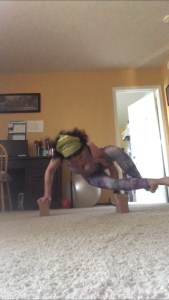
Here is a picture of me using blocks to get height on trying Astavakrasana (eight angle pose).
Straps
I really like to use straps to help me deepen a pose. There are different lengths of straps, so get one that is appropriate for your height, so you don’t have a lot of material that you have to hold onto. I am still working on my flexibility, so when I do Supta Padangusthasana A & B (Reclined Big Toe Pose), I use a strap to lengthen my leg. You can use them in Virabhadrasana III (Warrior 3 pose) and many others. You can also use then when trying to bind your arms, but your hands can’t reach each other.
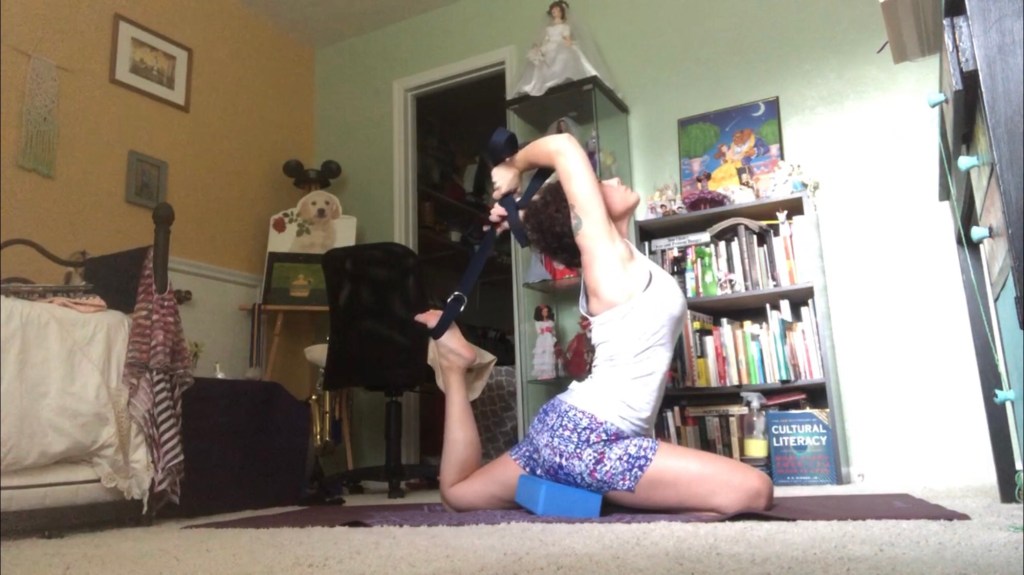
Here, I am using both a block and strap to do Eka Pada Raj Kapotasana (one leg king pigeon pose).
Blankets
Blankets are great to use when sitting in Sukhasana (easy pose) or Virasana (Hero’s pose). Just like a block, you can place the rolled up blanket under your sitting bones to keep your lower back from going forward. You can also use it between your calf and thighs to protect your knees when in supported virasana, or even sitting on the blanket. In restorative yoga, you can use a blanket in supported svasana (great article on tips for this).
Bolsters
Bolsters are awesome, however, a little pricey. They come in different shapes (rectangle, cylindrical, half moon, etc.). I wanted one, so I opted to make one. Here is a picture of mine:
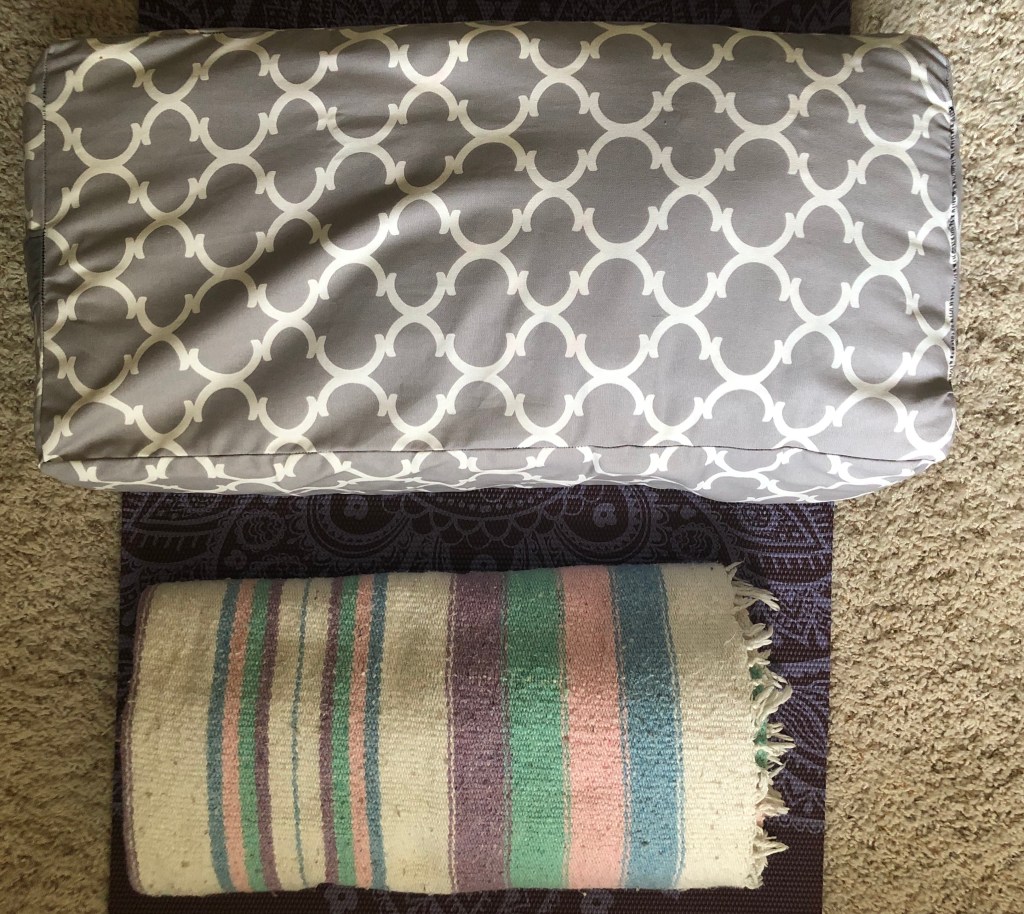
I found this pattern for it on Pinterest. If you are crafty, definitely give it a try. It was a pretty easy pattern. I used thick foam pads to fill it, since I had some left over from a project I previously did. I’ve also seen that you can use buckwheat hulls for the filling. The blanket in my picture I received as a gift from my mom many (many) moons ago when she went on vacation.
Like blankets, they are used for support. They are great when doing restorative fish pose (but can be used for so many poses).
Wheel
Finally, my favorite, is the yoga wheel. I don’t see it used as often, but I love to use it to stretch my back. You can also use it go get into supported headstand variations or even balance on it!
In a more active yoga class, I’ve used them in plank pose, using one leg and activating my core to keep your second leg parallel to the ground. I found a great article with additional ideas on how to use the yoga wheel.
These are my favorite props and the one’s I have at home. There are many other props that I didn’t list that you can also use (chairs, walls, sandbags, eye pillows, etc.). There are so many to name!! So if you ever feel like you need a little boost (or some chill time), go ahead and grab a prop!!


 Grounding Fitness, LLC
1 thought on “Props and Ways to Use Them”